
The Case Against strictly Barrel Aging
The Problems.
The barrel-aging process has become the biggest single limitation on so many levels. Here is a frank accounting of what it is costing you — and what it is preventing you from doing.

Tied-Up Working Capital
Every dollar you put into a barrel is a dollar that is locked away — sometimes for a decade or more — before it generates any return. Your working capital is not working. It is sitting in a warehouse, slowly evaporating, while your business needs cash to operate and grow.
The longer the required aging period, the more capital you must tie up just to maintain your production pipeline. For smaller and mid-sized distilleries, this is not just an inconvenience — it is an existential constraint on growth.

Flavor Profile Restrictions
Your product goes into a barrel that is invariably made of white oak or its tyloses-containing equivalent. Right there, flavor and aroma innovation is immediately stifled — non-tyloses-containing woods are not used to make barrels. You are also given basically Char #1 through Char #4 for your entire flavor profiling.
That's it. The entire flavor universe available to you through barrel aging can be summarized in a handful of char levels and a few species of wood. Pretty pathetic, actually.
Once your product is in the barrel, the barrel is in full control of the flavor profile that develops. You now have practically zero control at this stage.
Continuous Cost Burdens
The costs do not stop when the product goes into the barrel. They accumulate — month after month, year after year. Warehousing costs. Insurance. Barrel maintenance and cooperage. Climate control. Security. Labor. These are not one-time investments; they are ongoing drains on your operation for the entire duration of the aging period.
For a product that requires 8 to 12 years of aging, you are paying these costs for over a decade before you see a single dollar of revenue from that batch. The financial model of barrel aging is, at its core, deeply inefficient.

Product Losses — The "Angel's Share"
Barrel aging is a leaky process — literally. The so-called "angel's share" is the industry's poetic name for what is, in plain terms, product evaporation and loss. Depending on climate and storage conditions, a barrel can lose anywhere from 2% to 10% or more of its contents per year to evaporation alone.
Over a 10-year aging period, you may lose 20% to 40% or more of your original product volume. You paid to produce it. You paid to store it. And then a significant portion of it simply disappears into the air. This is not a rounding error — it is a structural loss built into the barrel-aging model.
Warehousing Costs & Logistics
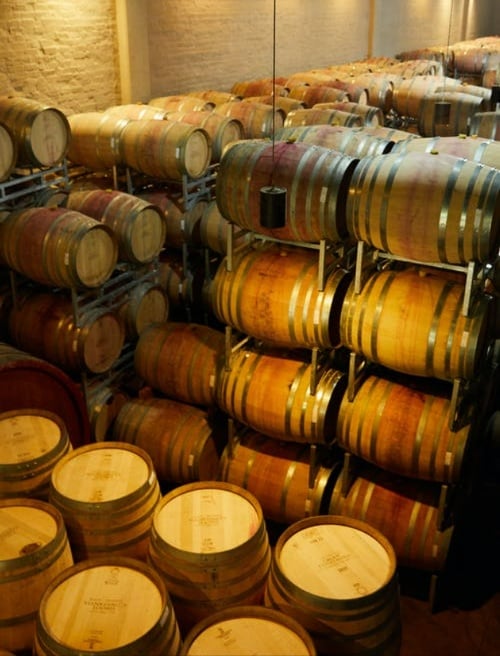
Barrels are large, heavy, and require significant physical infrastructure to store properly. Rickhouses, warehouses, and aging facilities represent enormous capital investments in real estate and construction — before you have stored a single barrel.
The logistics of moving, rotating, and managing thousands of barrels across a multi-year aging cycle add further operational complexity and cost. Every barrel must be tracked, inspected, and managed. The infrastructure required to do barrel aging at scale is staggering — and it is all in service of a process that takes years to produce a result.

Environmental Concerns
Every barrel charred to a Char #3 or #4 produces approximately ~25kg of harmful GWP gases into the atmosphere — furthering climate change effects now, and for your children's future.
Every barrel constructed uses a natural resource — white, French, Hungarian, Mizunara, and other oak species — that is becoming scarce and in tight supply. This is a short-sighted, non-sustainable, and self-defeating course of action.
Every barrel constructed represents a tremendous waste of sensitive natural resources: approximately 100 lbs. of wood yields less than 53 gallons of aged spirits. This is ridiculously inefficient and grossly wasteful.
The patented process uses ~93% less wood mass to achieve the same — or better — result.
Time. Years of It.
Perhaps the most fundamental problem with barrel aging is simply time. A good bourbon requires a minimum of 4 years. A premium Scotch whisky may require 12, 18, or 25 years. During all of that time, your capital is locked up, your costs are accumulating, your product is evaporating, and you are generating zero revenue from that batch.
The decisions you make today about what to put into barrels will not pay off for a decade or more. You are, in effect, running a business where a significant portion of your production capacity is permanently committed to a multi-year waiting game.
This is not a feature of barrel aging. It is the central problem with it.
"This makes equal or better product in less than an hour than a barrel does after 10 years of traditional aging."
The Problem, Summarized
The barrel-aging process has become the industry's biggest single limitation. Every one of these problems is solved — in an hour or less — by the patented process.
It is patented for a reason.
Ready to solve these problems?
The patented process addresses every one of these limitations — delivering barrel or better quality in an hour or less. Contact us to discuss licensing.